What is the philosophy of AI?
As we hurtle into a future shaped by advanced artificial intelligence, it is easy to get swept up in marveling at the coding complexities and technological feats of the intricate algorithms.
Yet beneath the layers of code and machine learning lies something perhaps more fascinating and certainly more consequential: the philosophical implications of AI.
This article aims to peel back the technological exterior, to delve into AI’s broader impact on our understanding of existence and humanity itself. Let’s not just gawk at the shiny new algorithm and miss the profound philosophical questions it raises.
AI and Philosophy: Posing Fundamental Questions
Artificial intelligence (AI) forces us to delve deep into long-standing philosophical debates. To start, let’s consider AI’s interaction with intelligence. We have to redefine what we perceive as intelligence, asking ourselves whether a machine’s ability to learn, adapt, and execute tasks fits our understanding of this concept.
Next, we must grapple with the question of consciousness in machines. Can they experience thoughts and emotions? Or is every action merely a product of pre-programmed algorithms devoid of individual consciousness?
Moving to the moral dimension, AI development and deployment throw up several ethical conundrums. It forces us to examine what limits we ought to impose on AI advancement to maintain a moral and ethical balance.
Then, there’s the question of AI rights. If AI attains a certain level of self-awareness and consciousness, do we grant them rights akin to human rights?
Let’s not forget about digital personhood. As AI becomes more sophisticated, it poses interesting questions about establishing identities in the digital realm. Do we extend the notion of personhood to AI entities?
Lastly, AI brings forth an intriguing challenge to our understanding of free will. If AI entities can make decisions and evolve autonomously, does this redefine our concept of free will?
With each of these philosophical quandaries, AI not only pushes the boundaries of our technological capability but also forces us to reevaluate and potentially reshape our understanding of life’s fundamental concepts.
The AI Conundrum: Mind or Machine?
Resurrecting age-old philosophical debates, artificial intelligence (AI) confronts us with an intriguing conundrum. Can we consider a ‘mind’—an entity capable of thoughts and emotions—to emerge from a statement nut like silicon, which purely exists as a physical substance that carries out computations? Such a scenario challenges distinct philosophical positions—dualism, which considers mind and body as separate entities, and materialism, which regards everything as material including mind.
The concept of strong and weak AI further complicates this issue. While weak AI denotes the systems performing tasks intelligently, strong AI infers systems that understand and reason. And here surfaces the famous ‘Chinese Room’ argument. Do machines really understand, or is it just a simulation of understanding?…
This debate throws light on subtle, intricate layers of artificial intelligence, making us ponder over the true nature of ‘understanding’. Thus, what seems like a quest to build more sophisticated machines, in reality, turns us into modern philosophers, exploring the mysteries of existence and consciousness.
AI’s Moral Predicaments: From Code to Conscience
Where do we draw the ethical boundaries for artificial intelligence? This question, posed by an esteemed AI ethicist, showcases the trouble of instilling AI not just with autonomy, but with morality. To illustrate, consider a self-driving car faced with two unavoidable outcomes – causing harm to the car’s passengers or to pedestrians. The ‘right’ decision here presents a problem for algorithm programmers.
The application of traditional ethical frameworks, such as utilitarianism, deontology, and virtue ethics, to AI has its limitations. Ensuring the greatest good for the greatest number of people, adhering strictly to rules, or acting according to virtues may not always yield optimal solutions in intricate, diverse situations that AIs may encounter.
What’s more, morality is fluid, influenced by individual assumptions and cultural contexts. Programming fixed moral codes into AI could lead to hard-to-retract and potentially harmful consequences. As humans continue to play essential roles in developing and deploying AI, the need for an ethical navigation roadmap becomes pressing.
Developing AI with moral inclinations is no simple task – it’s akin to walking a high wire while navigating a moral maze. But to avoid an unchecked progression towards artificial general intelligence, humans must remain key actors on this ethical stage, monitoring, deliberating, and guiding AI’s moral decision-making journey.
AI and Philosophy: A Dance of Mutual Influence
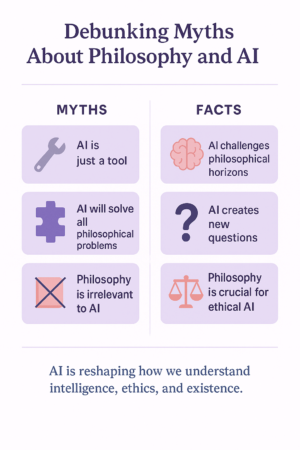
Beliefs about artificial intelligence and its relationship with philosophy tend to be bountiful and varied. Let us explore a few of these assumptions and shed light on erroneous conceptions.
One such belief presumes AI as a mere tool, obscuring its philosophical implications. In reality, AI morphs our philosophical perspectives profoundly, compelling our reevaluation of concepts such as intelligence, consciousness, and even humanness. In the presence of AI, philosophy extends not as a maturing discipline but as a haunted descendant, shadowed by its digital offspring.
Moreover, some anticipate AI as the all-knowing oracle, the resolver of all philosophical disputes. Yet, the advent of AI resurrects age-old philosophical dilemmas, even adding a new layer of complexity. The nature of consciousness, the ethics of autonomous machines, and the idea of digital personhood are just some of the enigmatic realms AI ushers.
Finally, the stealthiest myth of all – the alleged irrelevance of philosophy to AI innovation. Far from being irrelevant, philosophy is the ghost in the AI machine. It guides the ethical, responsible creation and application of AI, contemplating its potential impacts on society. Framing regulations, shaping future strategies, or nurturing a moral compass, philosophy unfurls as an indispensable ally for the journey of AI development.
These myths highlight an enduring truth: AI and philosophy are entwined in a dance of mutual influence, each reshaping the other in fascinating and unpredictable ways. As we further our quest for advancing AI, our understanding of philosophy molds and evolves, paving the way to shape our future harmoniously.
A Journey into AI: Five Philosophical Fundamentals
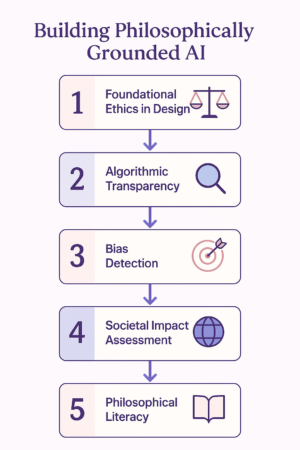
The link between AI and philosophy is not just about reflecting on these concepts; it’s about embedding them into the heart of AI development and education. Let’s break down this colossal task into five manageable steps, each offering a unique lens to view the puzzle of AI and philosophy.
Step 1: Begin with ‘Foundational Ethics in Design.’ This entails personifying the principles of moral philosophy within the AI design. Remember, building a virtual mind comes with the responsibility of bestowing it with the rudiments of right and wrong.
Step 2: Step into ‘Algorithmic Transparency and Explainability.’ The mystifying, black-box nature of AI systems often fuels skepticism. Distilling the complexity of algorithms into simple, understandable language secures trust and acceptance among users.
Step 3: Proceed with ‘Bias Detection and Mitigation.’ Bias hidden in datasets is an Achilles heel of AI, causing unintended repercussions. Cleanse your data from the infection of bias to ensure AI fairness.
Step 4: Tread towards ‘Long-term Societal Impact Assessment.’ The surge of AI technologies can echo in society for centuries. It’s essential to envisage the long-range implications of our actions today and adjust our strategies accordingly.
Step 5: Culminate at ‘Philosophical Literacy for AI Practitioners.’ As AI technology progresses, keep the flame of philosophical inquiry burning. Encouraging AI practitioners to equip and constantly update their philosophical toolkit persuades them to build AI that echoes human values.
Delving into philosophical concerns of AI may seem daunting. Tools like Edubrain can offer invaluable assistance. It’s a key support in navigating the myriad philosophical dimensions of AI, escorting learners step by step through the labyrinth of AI ethics and metaphysics. With firm support and a clear path, scaling the philosophical mountain of AI seems less formidable.
Necessity of Philosophy in Shaping AI’s Future
Turning a blind eye to the philosophical implications of AI could launch us into a murky future punctuated by unforeseen ethical dilemmas and societal risks. This future isn’t a mere possibility – rather, it looms as an inevitable outcome if we continue to separate philosophy from AI. The challenge is not just about creating brilliant AI systems that dazzle us with their technical prowess.
It’s about designing them to be philosophically aware, anchored in our human values, and crafted for societal progress. Uniting these dimensions requires a willingness to confront the uncomfortable and the unknown – to cast our gaze into the future and imagine what could be. Philosophy isn’t just important in our present conversations about AI; it holds a defining role in shaping AI’s future.
This shared journey, our dance with AI, isn’t just about the steps we take – it’s about the path we forge. The responsibility to guide AI’s philosophical trajectory rests on our shoulders. We are the architects and the philosophy tutors for the AI systems of tomorrow. The echoes of our actions will reverberate in the years to come, shaping not just our own future, but that of generations yet unborn.
So let’s strive for a future where AI is not just technically sublime, but philosophically proficient, the fruit of a truly enlightened society.
Points to Remember for the Futuristic Innovator
AI’s intimate dance with philosophy beckons us to ask deep existential questions. Establishing sound ethical structures is the bread and butter of responsible AI development. Unveiling AI’s philosophical implications empowers us to direct its future.
We cannot afford to bypass integrating philosophy into AI education and its subsequent development phases. These vital truths guide our journey as AI evolves from an algorithmic tool to a conscious entity.
What is consciousness in ai philosophy?
As we hurtle into a future shaped by advanced artificial intelligence, it is easy to get swept up in marveling at the coding complexities and technological feats of the intricate algorithms. Yet beneath the layers of code and machine learning lies something perhaps more fascinating and certainly more consequential: the philosophical implications of AI. This …
Do Algorithms Choose for Us? Free Will in the Age of Recommendation Systems
As we hurtle into a future shaped by advanced artificial intelligence, it is easy to get swept up in marveling at the coding complexities and technological feats of the intricate algorithms. Yet beneath the layers of code and machine learning lies something perhaps more fascinating and certainly more consequential: the philosophical implications of AI. This …